
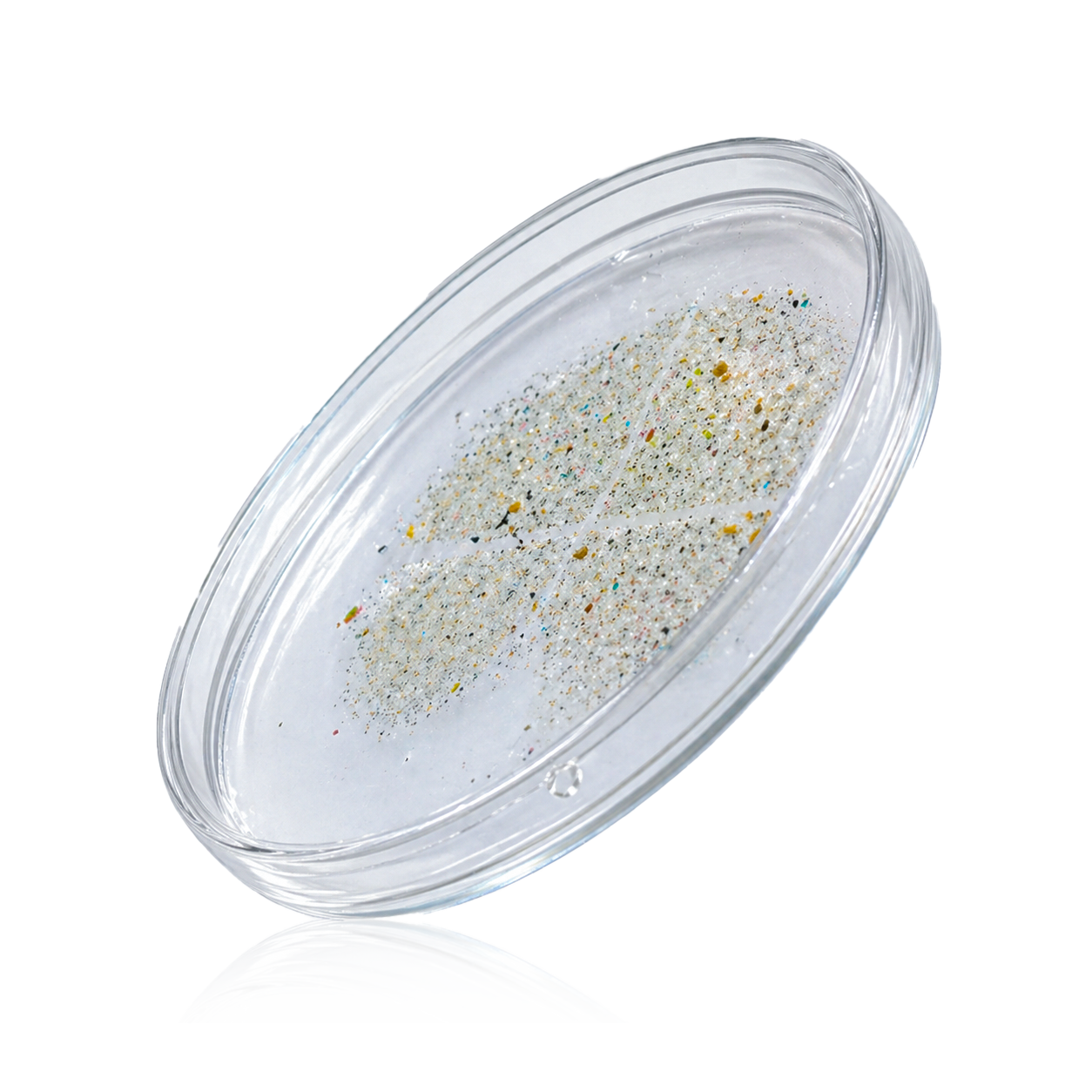
Laboratory Analysis
Discover how our testing solutions help quantify and classify microplastic levels in your water. At PolyGone, we prioritize precision and quality in all aspects of our microplastic analysis services utilizing our state of the art laboratory located in the New Jersey Bioscience Center.
PolyGone’s microplastic testing services are open to everyone. Whether you’re conducting academic research, managing industrial operations, or simply curious about the microplastic content in your tap water, we’re here to provide reliable and accurate results tailored to your needs.
All measurements taken in our lab are conducted using accredited methods including targeted microplastic staining, fluorescence microscopy, FTIR, and Pyrolysis GC-MS.
Our basic lab analysis service starts at $399 per sample.
Who We Serve
Utilities
Municipalities
Government Research Groups
Universities and Academia
Industry, Production, and Recycling Facilities
NGOs
Agriculture
Community Groups and Riverkeepers
Members of the public
Analytical Capabilities
-
A rapid, high-throughput technique for quantifying microplastics. Using fluorescent dyes such as Nile Red, particles are selectively labeled and imaged with a fully automated system (Invitrogen EVOS M7000), enabling complete sample analysis within 1–2 hours without the need for subsampling.
Applications:
Rapid quantification of microplastics larger than 1 µm across a wide range of sample types.
Included in the basic analysis service.
-
Fourier transform infrared spectroscopy (FTIR) is a widely used technique for the identification and quantification of microplastics. The Thermo Nicolet iN10 MX system at PMI is equipped with attenuated total reflectance (ATR), enabling direct, single-particle chemical characterization with high specificity.
Applications:
Identification of polymer composition when the chemical nature of particles is critical.
-
A highly sensitive analytical technique used for the chemical characterization and quantification of micro and nanoplastics. Samples are thermally decomposed into fragments, which are then separated and identified, enabling precise determination of polymer types and mass concentrations.
Applications:
Polymer identification and quantitative analysis of micro- and nanoplastics in environmental and industrial samples.
How Our Service Works
-
Submit a microplastics analysis request and purchase your lab test today via the ‘test my water today’ icon.
-
Follow the instructions provided below on how to submit your water sample: https://drive.google.com/file/d/1fi4dCYXALSL1Z5Uk_ZxBMWrU7f3LTpcU/view?usp=sharing
-
Wait for our team to process and analyse your sample in our laboratory using your desired analysis methodology.
The typical lead time for this process is 2 weeks
-
Receive your final report
Certifications & Qualifications
Our team comprises experienced chemists and analysts trained in the latest microplastic identification techniques. With extensive experience handling diverse water samples—including domestic water, natural water, and wastewater—we understand the unique challenges of each.Our procedures strictly adhere to ASTM standard D8333-20, ensuring the accurate preparation and analysis of water samples with varying levels of suspended solids to identify and quantify microplastic particles and fibers. Our laboratory is an ISO certified Wetlab, located in the New Jersey Bioscience Center with partner facilities in Princeton University.


What We Test
Drinking/bottled water
Wastewater
Surface water
Ground water
Industrial Process Water
Soil/sludge/compost
Food samples/Beverage samples
Clothing
Cosmetics